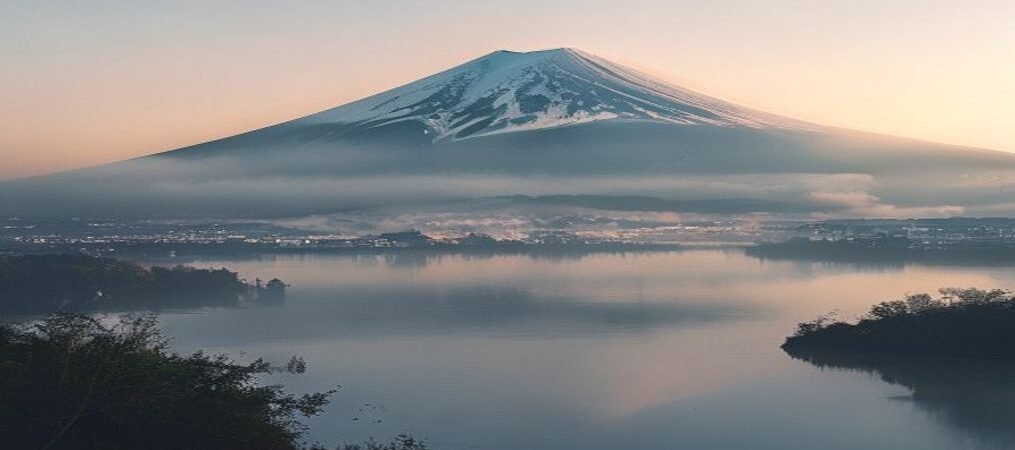
From Jōmon pottery to the Senkaku question. An attempt.
I. Origin — The Foundation
Japan is not a country that invented itself. It absorbed — and each time made something different from what it took in.
Jōmon (14,000 – 300 BCE): Sedentary hunter-gatherers. That is rare. Japan’s islands were naturally abundant enough to support settled life without constant movement. The first paradox of a country that to this day lives in contradictions.
Yayoi (300 BCE): Rice cultivation arrives from the continent. With it: hierarchy, property, war. Japan takes in the foreign — and transforms it. This will become a pattern that holds to this day.
Heian (794 – 1185): China brings writing, Buddhism, administration. Japan adopts all of it — and in doing so invents Hiragana, because Kanji is too large for Japanese feelings. Lady Murasaki writes what many consider the first novel in human history. Its subject: not heroes, not gods — the transience of beauty. Mono no aware (物の哀れ). The pathos of things.
Edo (1603 – 1868): Japan closes itself off for 250 years. Sakoku — the sealed barrier. In this isolation, it produces: haiku, kabuki, ukiyo-e. Matsuo Bashō writes in 1686 the most famous seventeen syllables in history:
古池や
蛙飛び込む
水の音An old pond —
a frog jumps in,
sound of water.
The entire universe in seventeen syllables. Not described — heard.
II. What Carries It — The Philosophical Layer
Three ideas that run through Japan like roots — and together make the “absorb without becoming” principle possible:
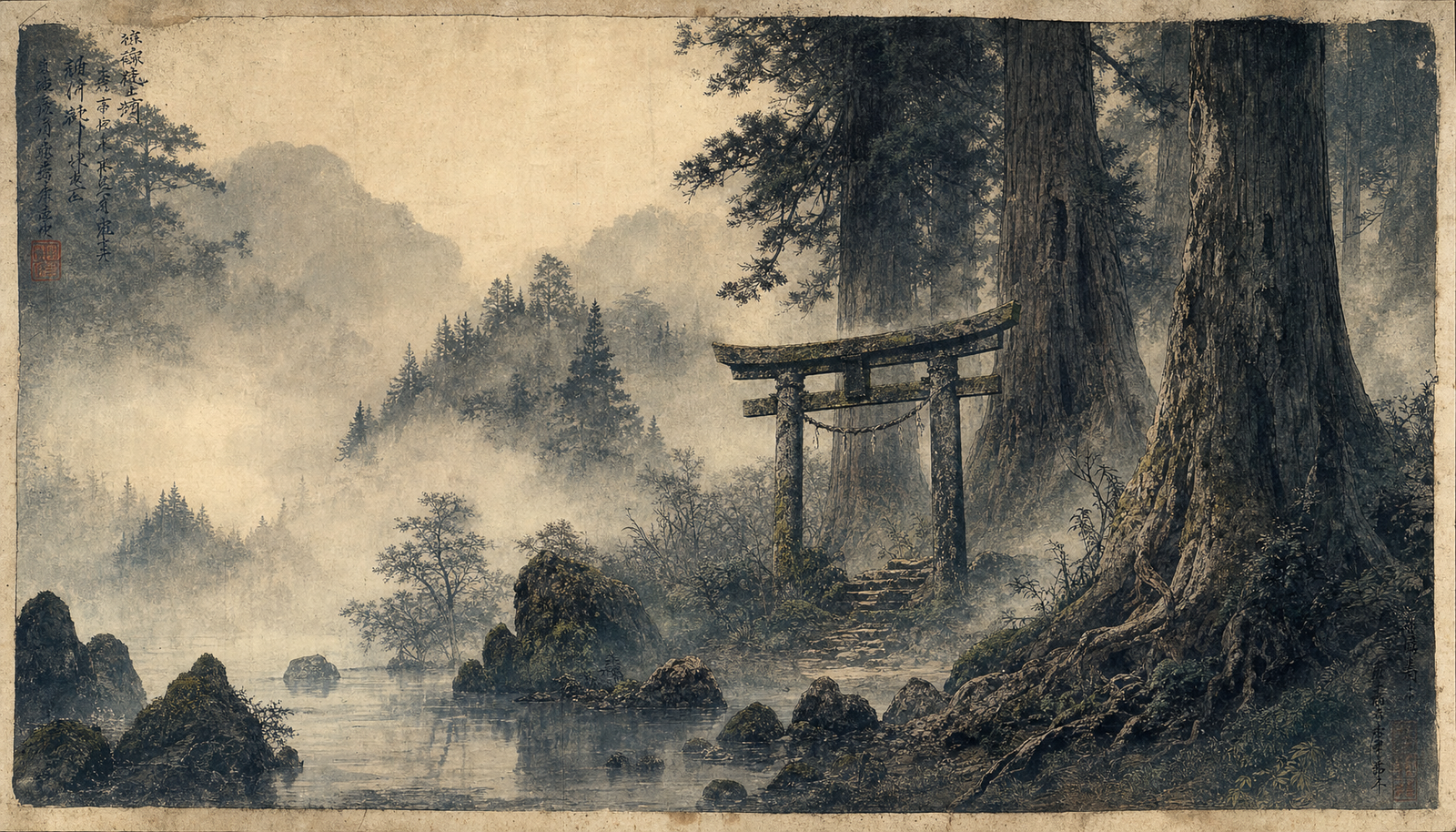
Shinto: No theology. No founder. No doctrine. Every stone, every river, every tree has kami — spirit, presence, dignity. This is not a primitive stage of religion. It is a philosophical position: matter is not dead. The world is alive. The consequence is not environmentalism in the Western sense — nature as an object to be protected from a distance. The consequence is natural belonging: you are already inside it.
And that is why Shinto is so hard to destroy.
The Meiji regime (1868–1912) tried. It built a state apparatus out of the immanent web: emperor cult, justification for war, nationalism. It pressed Shinto into an ideology. After 1945 that apparatus was finished — formally dissolved, America no longer permitting a “state religion.” And Shinto was still there. At local shrines, in the seasons, in the walkway beneath the torii gates.
The state had used something that was never its to use.
Christianity has a church. Islam has a Sunna. Buddhism has a Sangha. Shinto has — the frog that jumps into the water. You can take the form. Not the content.
Wabi-Sabi: The beauty of the unfinished, the broken, the transient. Kintsugi — cracked pottery repaired with gold lacquer, the fracture line left visible, not hidden. What was broken becomes more precious because of the break. The West conceals damage. Japan displays it. This is what makes absorption without anxiety possible: imperfection is not loss, it is evidence of contact.
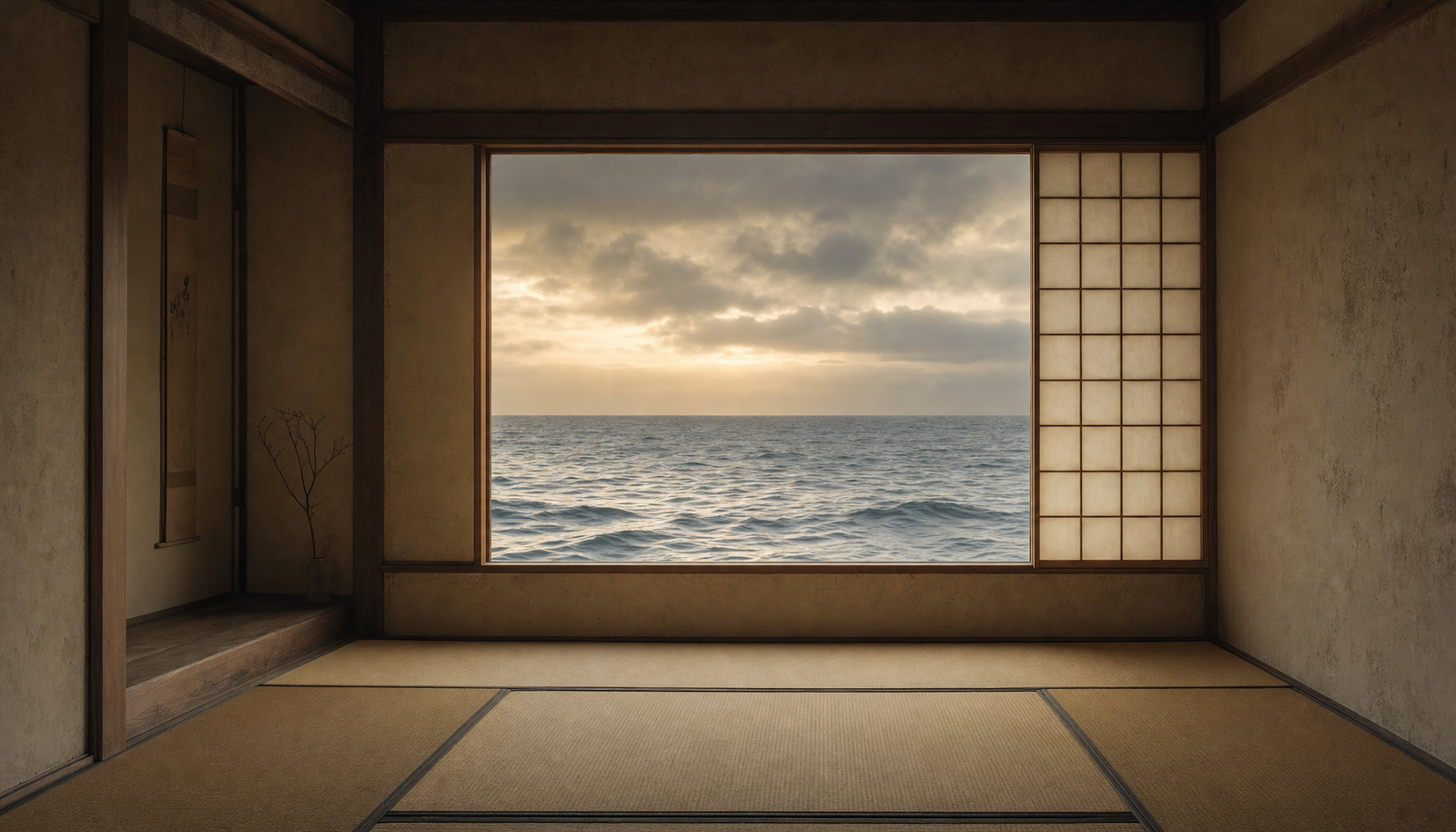
Ma (間): Negative space. Pause. Silence. The empty room is not empty — the space between things is the actual thing. In conversation: silence is speech. The West fills. Japan holds open. This patience with incompleteness is what lets foreign elements settle and transform rather than be forced or rejected.
III. The Tension — Shinto and Geopolitics
This is where it gets difficult. And therefore interesting.
Japan is in one of the largest security transformations since 1945. The defense budget has grown for twelve consecutive years, moving toward 2% of GDP — a target unthinkable for decades. Under discussion: long-range missiles, expanded arms exports, revision of the Three Non-Nuclear Principles. Prime Minister Takaichi has said publicly that Japan could intervene militarily if Taiwan is attacked. That is a statement no one would have made even a few years ago.
The driver is China.
Senkaku Islands (尖閣諸島): Administered by Japan, claimed by China. Small, uninhabited rocks in the East China Sea. No conventional military value — but enormous symbolic weight. China regularly tests Japan’s response: patrol vessels entering Japanese waters, drone incursions, sustained pressure without direct attack. Not a single event. A long test.
Taiwan: 110 kilometers from the Japanese island of Yonaguni. What happens in Taiwan happens at Japan’s doorstep. Energy supply routes, regional balance, the entire geopolitical architecture of East Asia — all of it depends on this threshold.
The paradox:
Shinto says: the sacred is here, in this stone, this river, this bay. For many Japanese, the Senkaku Islands are not merely strategic territory — they are, in a deeper sense, inhabited space, kami-ground. There lies the tension: Japan is defending something immanent with means that are entirely formal. Missiles, budget lines, bilateral agreements.
The Meiji regime once used Shinto for exactly this kind of strategic purpose — as state religion, as justification for expansion. It took the form and lost the soul. Lost the war. Left the country in ruins.
The question for Japan in 2026: can it transform itself militarily without undergoing the same hollowing out?
Bashō’s frog gives no political answer. But it poses the right question: what is actually jumping here — and into which water?
IV. Where To — The Open Future
Two realities that coexist without resolution:
Contraction: By 2100 Japan may have 80 million people, down from 125 million today. Not catastrophe — but structural shrinkage. Hikikomori — millions who retreat entirely into their rooms. A society under pressure, living an extreme form of ma: total withdrawal as a response to unbearable expectation.
Expansion: At the same time, Japan exports culture more intensely than ever before. Anime, manga, ramen, Marie Kondo, Nintendo, Miyazaki. Spirited Away is a Shinto film — no one explains it that way, but everyone feels it. The kami now live in pixels. Japan shapes the world while it withdraws from itself. This is not decline. It is a new paradox in a long line of paradoxes.
Article 9: The pacifism clause of the 1947 constitution — written by America, in the shadow of the atomic bomb. It kept Japan outside military logic for 70 years. Now it is under sustained pressure. The semantic dance is typically Japanese: maintain the form while the content shifts. “Self-Defense Forces” instead of an army. “Counter-strike capability” instead of first strike. Until the words no longer fit.
The debt: Japan carries one of the highest public debt loads in the world — well above 200% of GDP. More defense spending, fewer taxpayers, a shrinking economy. The grand geopolitical ambition and the fiscal reality do not stand comfortably together.
V. The One Principle
Japan has survived — Mongol invasions (repelled by the kamikaze, the divine wind), 250 years of self-imposed isolation, forced opening, imperialism, defeat, atomic bomb, reconstruction, and economic stagnation — through one principle:
To absorb without becoming.
It takes in the foreign: Chinese characters, Buddhism, democracy, capitalism, the internet. Transforms it into something Japanese. Keeps a core that is difficult to name — but that both Bashō and the Fuji webcam point at.
Now: China as pressure, America as partner, Taiwan as threshold, rearmament as necessity.
The question is not whether Japan will militarize. That is decided. The question is: will Japan absorb this transformation — and make something Japanese of it? Or will it lose, in the process, what it is trying to defend?
The Meiji regime answered that question badly. It took the form for the state. Form does not survive when separated from the soul.
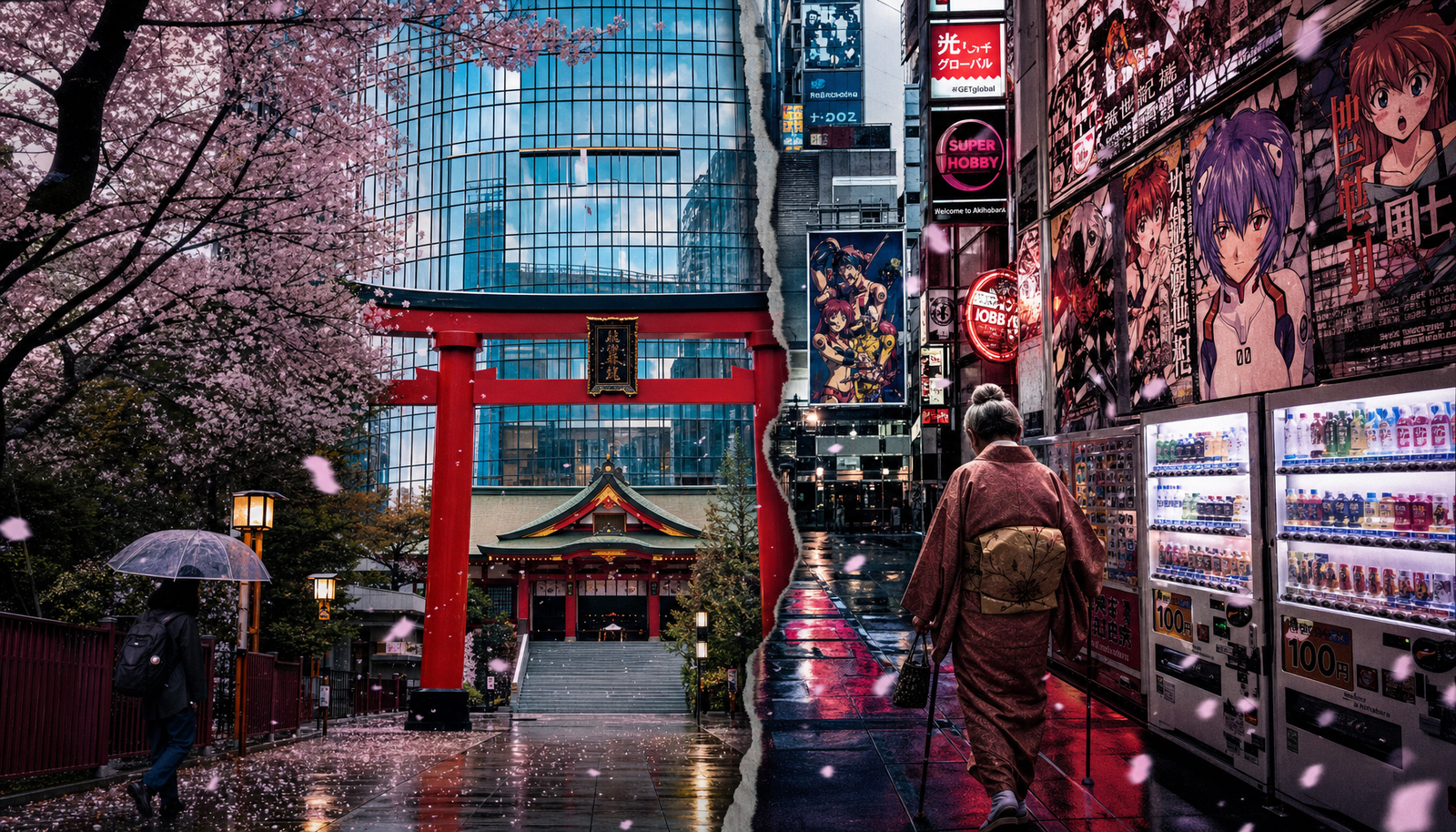
The shrine between the concrete walls knows this.
The frog leaps.
The water sounds.
The Senkaku question stays open.
So does the poem.
Philosophical and historical interpretations are the author’s own synthesis. Figures on debt and demographics are illustrative orders of magnitude. All four illustrations are AI-generated. Written May 8, 2026.
Leave a Reply